Four equal players entered with 30 billion chips each. After the ante, each displayed stack was 29.9 billion—almost unchanged. Yet the learned agents quickly converged on a conspicuous behavior: frequent all-ins, including weak holdings and early streets. They built enormous pots against one another and often exited early.
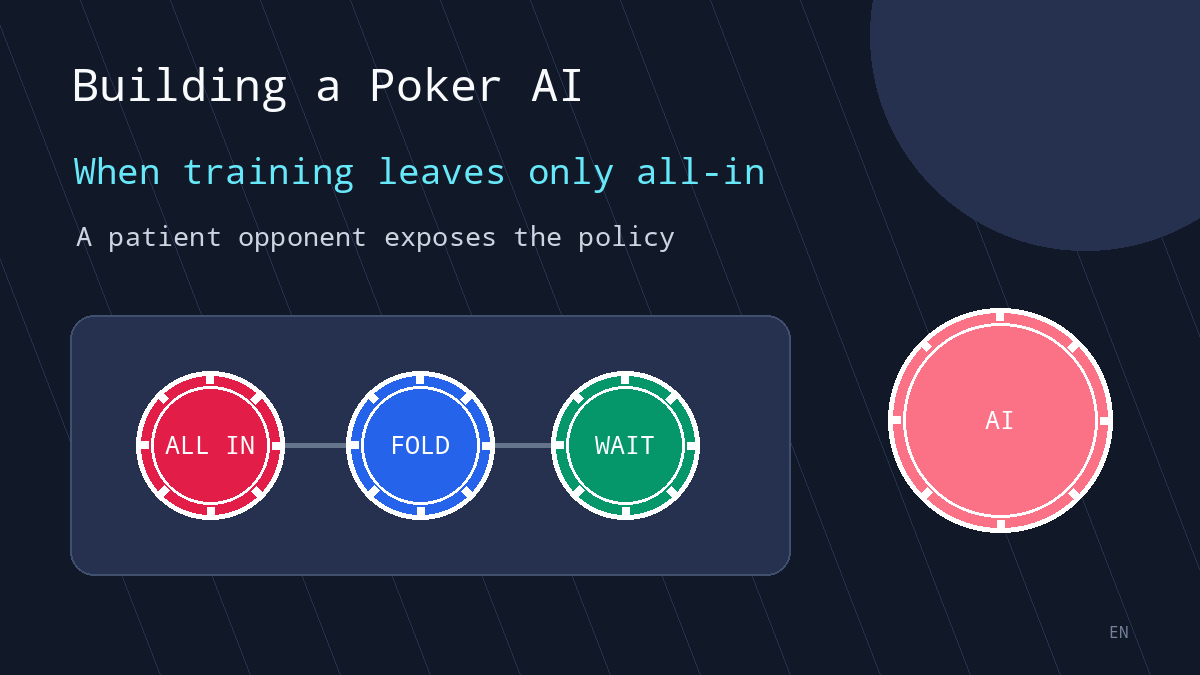
The human did not need a brilliant counterstrategy. Weak hands were folded, the agents were allowed to collide, and chips went in only when hand strength and context justified it. The eventual win does not show that the human played perfect poker. It shows that a stable, simple response could exploit a repeated defect in the opponents' policies.
The probability claim needs care. With four truly equal players and no other information, the symmetric prior share is 25% each. Once one player folds out of contention for that hand, the three remaining players have a conditional symmetric share of `1 / 3`, or about 33.33% each. It does not become 3.4. Real equity still depends on hole cards, board, betting, and stacks; this calculation is only a player-count baseline.
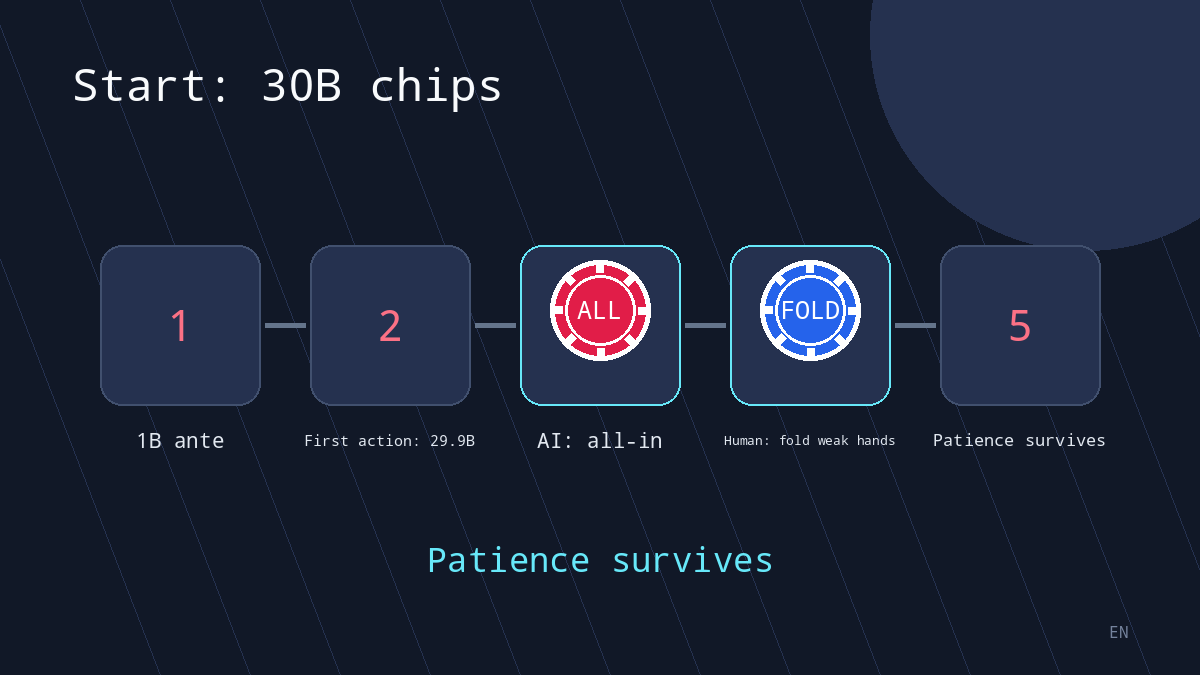
The recurring flow was straightforward: an AI shoved early, the human discarded a weak hand, the agents fought an elimination pot, and the human entered later from a better spot. Folding did not create chips immediately, but it avoided poorly compensated variance and preserved future decisions. The agents repeatedly exposed an entire stack before establishing a meaningful edge.
This is therefore evidence of exploitability, not evidence that all-in is optimal. One memorable showdown or one final winner cannot establish optimality. A defensible analysis must track shove rate by street, strength when shoving, survival and fold outcomes, and stack trajectories over many seeds. The match was useful as a diagnostic observation: it gave us a reproducible symptom and a concrete reason to inspect rewards and action preferences.
COMMENTS · CHAPTER 01
The Human Waited While the Poker AIs Kept Shoving 0 comments
No comments yet. Leave a question or anything you would like to add.
To post a comment, continue with Google and register a nickname and email address.
Continue with Google