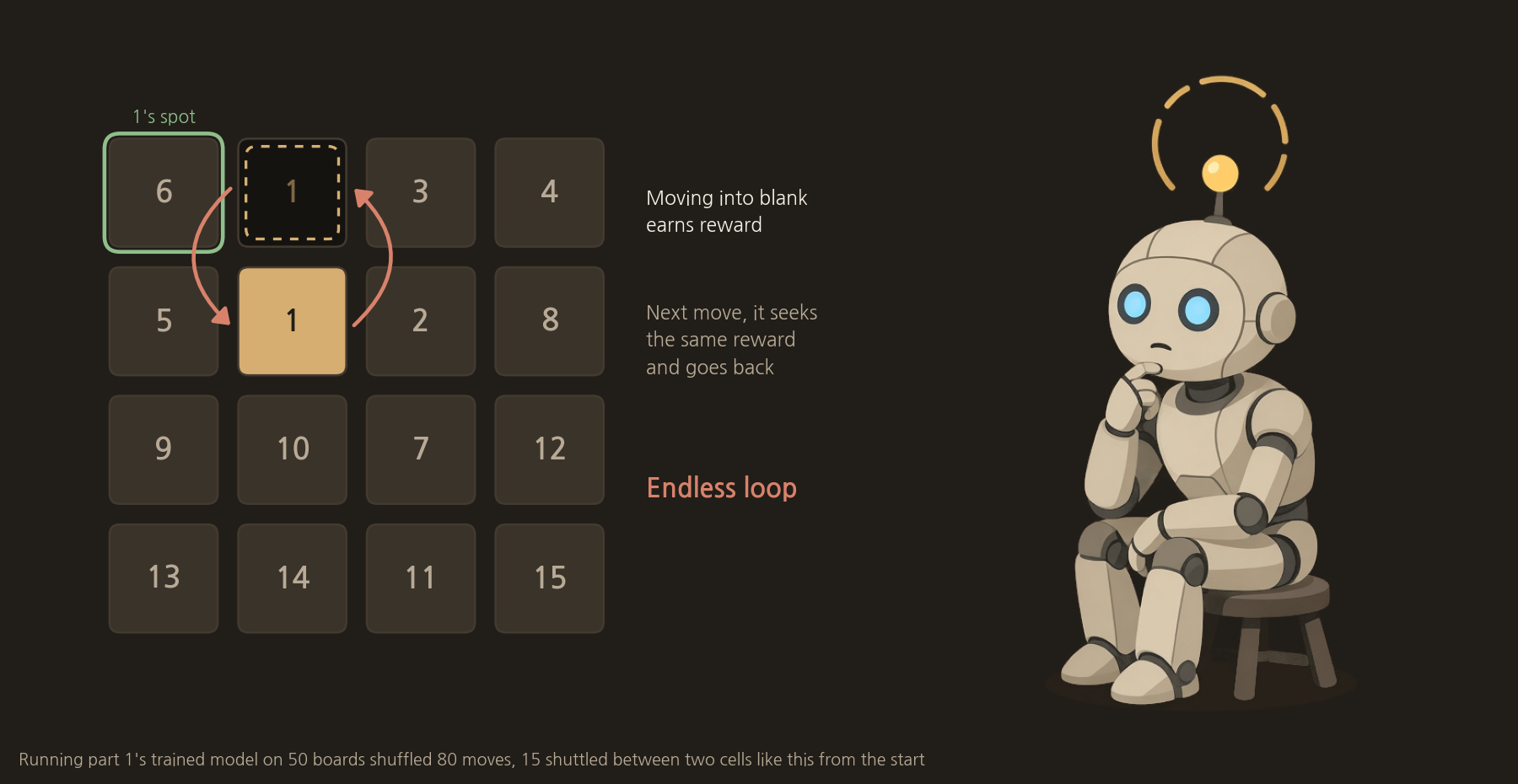
In my view, the reason AI cannot understand such an easy rule, one that people can grasp, is that all of AI's learning is based on future reward. As I said earlier, you have to put the empty cell after the number and turn the loop. But if the number gets a reward for moving into the empty cell, the same thing happens next time, and the number tries to move back into the previous empty cell to get the reward again. After that, as we have already seen, it falls into an infinite loop.
This problem does not exist for the heuristic. A heuristic is a combination of IF statements, so there is no such thing as future reward to begin with. That is why the heuristic gets past this hurdle easily.
Where the heuristic beats AI is that, depending on the hardware, the heuristic is currently far faster and more accurate. AI moves based on probabilities, so as technology advances and hardware improves, it will likely produce results faster than any heuristic some day. But now and then there are problems that a heuristic can solve and AI never can.
AI's existing training method is greed. If AI comes close to human intelligence, or surpasses it in the near future, then whatever wrong AI does will all come from human greed. If existing AI training methods reflected the results of good intentions rather than greed, training would take longer, but AI would not cheat or betray its colleagues out of greed as it does now.
I think this problem is a good example of training an AI with a heuristic that has no greed as its teacher.
The full source and the models used are in the post "4. The full source code and the models used".
COMMENTS · CHAPTER 03
Why can't AI learn this rule? 0 comments
No comments yet. Leave a question or anything you would like to add.
To post a comment, continue with Google and register a nickname and email address.
Continue with Google